
Best Restaurants in Panama for a Business Lunch or Dinner
Panama City runs on relationships built over meals, more than most Latin American capitals its size. As a regional banking and logistics hub anchored by the Canal, the city sees a constant flow of executives, shipping representatives, and finance professionals who close as much business over lunch as they do in a conference room. That makes the question of where to eat in Panama for work purposes genuinely different from where to eat for pleasure, and it deserves its own answer.

A restaurant built for business needs to solve for a narrower set of problems than one built for tourism or celebration. Noise level matters more than atmosphere, because a negotiation conducted at a shout is a negotiation that goes badly. Table spacing matters more than décor, since confidential conversation requires real distance from the next party. And service speed matters in a way it does not for a leisurely dinner, particularly at lunch, when a visiting executive may have a flight or a second meeting immediately after.
Bella Vista and El Cangrejo handle the bulk of this demand simply through proximity to the financial district and major hotel chains. Business travelers staying in those areas rarely need to leave a five-block radius to find a competent lunch spot, and that convenience, more than any culinary distinction, is what keeps those restaurants full on weekdays. It is a functional solution rather than a memorable one, and most executives treat it as exactly that.
Casco Viejo occupies a different, often underused role in Panama’s business dining scene: the closing dinner. When a deal is nearly finished and a visiting partner deserves a meal that signals the relationship matters beyond the transaction, the old town is where that dinner tends to happen. A restored colonial dining room says something a hotel conference room cannot, and a menu built around Panamanian ingredients gives an international guest something specific to remember about the country, not just the deal.
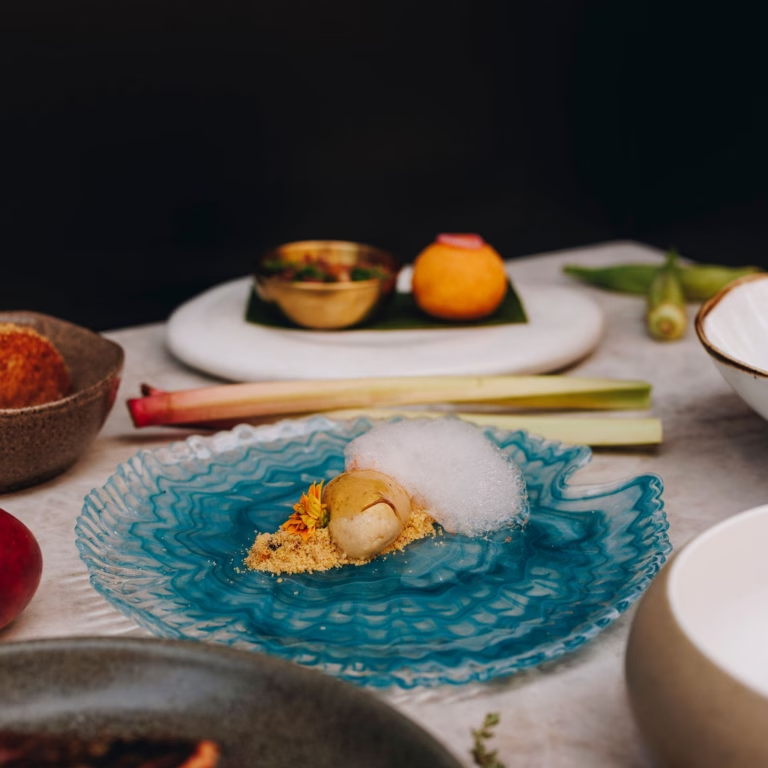
Kaandela sees this pattern regularly: smaller parties, often four to eight people, arriving directly from a day of meetings in the financial district for a dinner meant to mark the end of a negotiation rather than the middle of one. The restaurant’s layout accommodates that use case well, with seating arrangements that allow a private conversation without requiring a fully enclosed room, and a pace of service suited to a dinner meant to run two hours rather than forty-five minutes.
For groups that need full privacy, whether for a sensitive negotiation or simply a larger party celebrating a signed contract, private dining space becomes the deciding factor rather than the menu itself. Casco Viejo’s restaurants, many housed in converted colonial residences, tend to have more flexibility here than newer buildings in the financial district, since the original architecture often includes smaller rooms and courtyards that adapt naturally into private dining areas.
Timing advice for business travelers differs from the advice given to tourists. Lunch reservations in Casco Viejo rarely need to be made more than a day ahead, since the district’s daytime foot traffic skews toward visitors rather than the office lunch crowd found in Bella Vista. Dinner is the opposite: a closing dinner planned for a Thursday or Friday evening should be booked as early as the trip itself is confirmed, since the same restaurants that handle daytime meetings well also become the city’s most requested dinner reservations on weekend evenings.
The broader point for anyone planning restaurant strategy around a Panama City work trip is that the city rewards matching the meal to its purpose rather than defaulting to convenience. A quick weekday lunch near the office does its job in Bella Vista. A dinner meant to leave an impression, seal a relationship, or simply mark real progress on a deal belongs somewhere with more weight behind it, and Casco Viejo, with kitchens like Kaandela built around Panamanian technique and ingredients, is where that weight tends to live.
Panama’s role as a regional logistics and banking hub means business travelers arrive from an unusually wide range of countries, often within the same week. A restaurant that hosts a lunch with Colombian shipping partners on Monday and a dinner with European finance executives on Thursday needs a kitchen and a service style flexible enough to feel appropriate to both without feeling generic to either. This is part of why Panamanian cuisine, rather than an imported international menu, tends to work better for these meals than expected: it gives every visiting party something specific and unfamiliar to talk about, rather than a menu that reads the same in Panama as it would in Miami or Madrid.
Group size is worth planning around more carefully for business meals than for social ones. A negotiation dinner for three or four people has far more restaurant options available on short notice than a signing celebration for fifteen, and Casco Viejo’s smaller colonial dining rooms, while excellent for the former, can struggle to accommodate the latter without significant advance notice. Anyone organizing a larger business gathering should confirm capacity directly with the restaurant well before the date, rather than assuming a well-known kitchen can simply expand seating on request.
Dietary accommodation deserves a mention specific to business dining, since visiting executives increasingly arrive with specific restrictions, whether religious, medical, or preference-based. Restaurants working closely with local producers tend to handle these requests more gracefully than kitchens built around a fixed, pre-set international menu, simply because a smaller, ingredient-driven kitchen has more flexibility to adjust a dish than one locked into a rigid, high-volume format. Flagging dietary needs when making the reservation, rather than at the table, gives the kitchen time to prepare properly rather than improvising under pressure.