
Panama City Restaurants by Neighborhood: A Complete Map
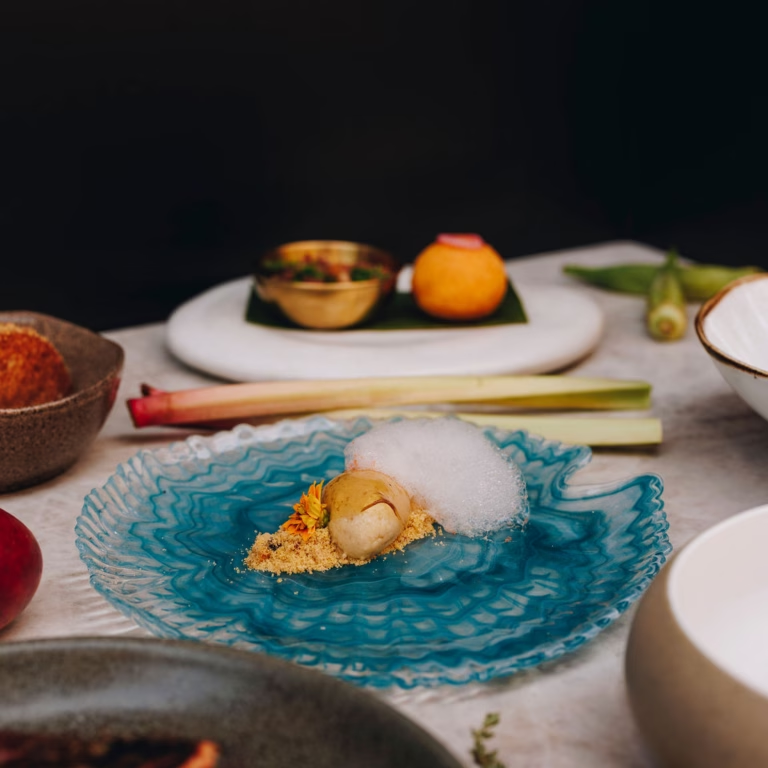
Ask someone where to find good restaurants in Panama City and you will usually get an answer shaped by whichever neighborhood they live in, because the city's dining scene does not behave like one unified market. It behaves like five or six smaller ones stitched together, each with its own price point, pace, and reason for existing. Knowing which district you are actually asking about does more to narrow down a good meal than any generic "best restaurants" list ever could.

Casco Viejo, the restored colonial peninsula at the city’s southern tip, is the district most visitors picture first. Narrow streets, French-influenced balconies, and a skyline view across the bay toward the modern towers of Punta Pacifica make it feel like a different city entirely. The food here leans toward slower, more considered dining: wood-fired kitchens, wine bars tucked into converted colonial houses, and rooftop terraces built for sunset. Kaandela sits in this category, built around live-fire cooking and Panamanian ingredients, and it draws both hotel guests staying nearby at properties like Amarla and locals making a special trip across town.
El Cangrejo and Bella Vista, just north of the causeway, form the city’s most walkable commercial corridor outside the old town. This is where Panama City’s professional class eats lunch on a weekday and where a denser concentration of international cuisines shows up: Peruvian ceviche counters, Lebanese grills, Italian trattorias, and a steady rotation of newer concepts opening in refurbished storefronts. It is convenient, well-lit, and easy to reach, but it rarely produces the kind of destination dining that makes someone plan a trip around a single meal.
Obarrio sits between the financial district and the causeway and has quietly become one of the more interesting pockets for chef-driven cooking, largely because rents there are still lower than in the glass towers of Punta Pacifica or Costa del Este. Smaller dining rooms, shorter menus, and a willingness to experiment define the neighborhood more than any single signature dish. It rewards regulars far more than tourists passing through once.
Costa del Este, on the eastern edge of the city near Tocumen, reads almost like a suburban dining district transplanted into a capital city. Shopping centers anchor most of the restaurant activity, catering to families and residents of the newer high-rise developments rather than visitors. The food is competent and often good, but the setting rarely competes with the character of the older parts of town, and few travelers make the trip specifically to eat there.
Punta Pacifica and the area around the causeway split the difference between business dining and leisure. Hotel restaurants, marina-adjacent seafood spots, and a handful of higher-end concepts serve a mix of business travelers and Panama City residents celebrating something. It is polished and consistent, though it can feel interchangeable with international hotel districts almost anywhere else in Latin America.
What ties all of these districts together is that “restaurants in Panama City” as a single category barely means anything without a neighborhood attached. A traveler asking for the best restaurant experience in the capital is really asking a more specific question: do they want history and atmosphere, in which case Casco Viejo wins clearly; do they want convenience near a business meeting, in which case El Cangrejo or Bella Vista makes more sense; or do they want a quieter evening away from the tourist path, in which case Obarrio deserves a look.
For visitors staying in Casco Viejo, the good news is that the old town rarely requires a trip elsewhere. Between the wine bars along the seawall, the rooftop terraces overlooking Panama Bay, and kitchens like Kaandela built around slow-cooked, fire-based menus, the neighborhood covers most of what the newer districts offer, just with several centuries more character wrapped around it. Cross-town trips make sense for a specific dish or a specific reservation, but they are rarely necessary just to eat well in Panama City.
Transportation shapes this neighborhood divide more than most visitors expect going in. Panama City has no metro line connecting Casco Viejo directly to the financial district or Costa del Este, and while a metro system does serve parts of the city, its routes were built around commuter corridors rather than tourist or dining circuits. That means moving between districts almost always means a car, whether a rideshare, taxi, or rental, and traffic on the Cinta Costera and Avenida Balboa during peak hours can turn a fifteen-minute trip into forty-five. Planning a single evening around two different neighborhoods is possible, but it works far better as a deliberate choice than as an improvised one.
Real estate history explains a good part of why the districts feel so different from each other in the first place. Casco Viejo’s restoration, which accelerated meaningfully over the past two decades after decades of neglect, preserved small colonial buildings rather than replacing them, which is why its restaurants tend to be intimate and architecturally distinct. Costa del Este and Punta Pacifica, by contrast, were built largely from scratch on reclaimed or previously undeveloped land, favoring large, modern structures designed around parking and mall-style retail rather than pedestrian streets. Neither approach is accidental, and understanding that history explains the atmosphere of each district better than any restaurant review can.
Visitors staying in a hotel far from Casco Viejo sometimes ask whether it’s worth relocating mid-trip just for the dining scene. For anyone with more than three or four days in the city, the answer is generally yes: the time cost of commuting into the old town for dinner repeatedly adds up faster than the one-time cost of moving accommodations, and staying inside the district transforms the entire experience from a series of planned excursions into something closer to simply living there for a few days.