
Best Restaurants in Panama City, Panama for First Time Visitors
The best restaurant in Panama City for a longtime resident and the best restaurant in Panama City for someone landing at Tocumen for the first time are often not the same place, and that gap is where a lot of first-time visitors go wrong. Locals optimize for novelty, for a specific dish they have been craving, or for proximity to home. Someone visiting for three or four days is optimizing for something different: a meal that captures what makes Panama distinct, in a setting that feels safe and easy to navigate without prior knowledge of the city.

That distinction matters because most “best restaurants in Panama City” lists are written for people who already live there. They assume you know which taxi apps work reliably, which neighborhoods feel comfortable after dark, and which reservation systems are actually monitored. A first-time visitor needs a shorter, more forgiving list, weighted toward places that are easy to reach, easy to book, and unlikely to disappoint regardless of when you show up.
Casco Viejo solves more of that problem than any other district in the city. It is walkable, well-lit along its main routes, dense with restaurants and bars so a bad first choice rarely ruins an evening, and visually distinct enough that getting oriented takes minutes rather than days. Most hotels aimed at international travelers, including Amarla, are positioned inside or immediately adjacent to the old town for exactly this reason. You can land, unpack, and be seated at dinner within an hour without ever needing to figure out the city’s broader geography.
Within Casco Viejo, the restaurants that serve first-time visitors best tend to share a few traits. They offer a menu that is recognizably Panamanian rather than a generic international spread, since eating something specific to the country is usually part of the reason for the trip. They have English-speaking staff, not because Spanish is a barrier but because clear communication reduces friction on a first night in an unfamiliar country. And they have a setting distinctive enough that the meal becomes part of the memory of the trip, not just background to it.
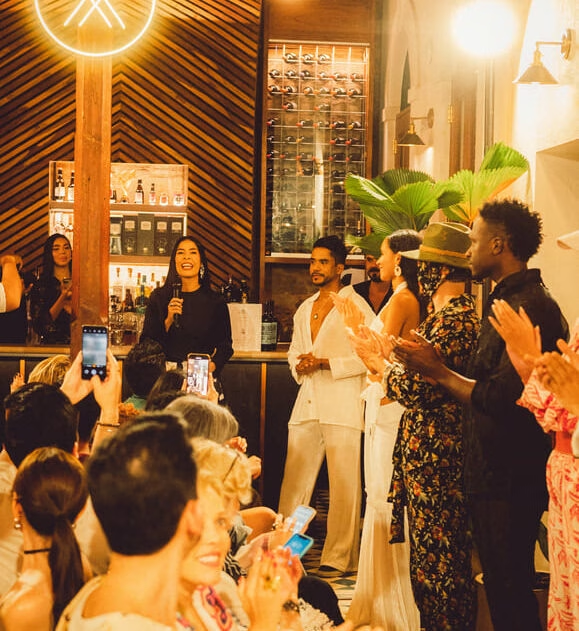
Kaandela was built with that visitor in mind as much as the local one. The kitchen’s approach, built around wood-fired cooking and ingredients sourced from Panamanian farms and coastal producers, gives a first-time guest a clear sense of place rather than a menu that could belong to any city in the region. The setting inside a restored colonial building does the rest of the work, giving the meal a backdrop that explains, without needing much explanation, why Casco Viejo is worth the trip on its own.
Timing is worth planning around on a first visit. Panama City restaurants, especially in the old town, get significantly busier after 7:30 p.m. on weekends, and a table without a reservation becomes a genuine gamble rather than a minor inconvenience. First-time visitors unfamiliar with that rhythm often assume a city of this size will have more slack in its dining capacity than it actually does. Booking ahead, even a day in advance, removes one of the few variables that can derail an otherwise smooth first night.
It is also worth setting expectations about pace. Panamanian dining, particularly in a destination-style restaurant, tends to run slower than a quick international dinner. Courses are spaced out, service is attentive rather than rushed, and a full meal can comfortably stretch past two hours. Visitors expecting a fast turnaround, especially those coming from cities where dinner is transactional, sometimes read this pace as slow service rather than what it actually is: a kitchen giving fire-based cooking the time it needs.
The single best piece of advice for a first-time visitor choosing where to eat in Panama City is to resist the urge to maximize variety on night one. It is tempting to research five different neighborhoods and try to sample all of them in a short trip, but that approach usually produces a scattered, exhausting itinerary. Anchoring the first night in Casco Viejo, at a restaurant built specifically around Panamanian ingredients and technique, gives a far better introduction to the country than a rushed tour of the city’s more generic dining districts ever could.
Money matters worth settling before the first night out include how the country handles currency and cost. Panama uses the US dollar as its official currency alongside its own coins, which removes an entire layer of confusion that first-time visitors to other Latin American countries often face. There is no exchange rate to calculate at the table, no leftover foreign coins to figure out what to do with, and no need to track a fluctuating rate across a multi-day trip. A restaurant bill in Panama City reads exactly the way a bill would at home for any visitor coming from the United States, which removes one more small source of friction from a first night out.
Language is a smaller barrier than many visitors assume, particularly in Casco Viejo, where the tourism economy has pushed most established restaurants toward at least functional English among serving staff. That said, a few basic Spanish phrases, a greeting, a thank you, a request for the check, go a long way toward a warmer welcome, and Panamanians in the hospitality industry generally respond well to visitors making even a modest effort rather than assuming English by default. A first-time visitor willing to attempt a little Spanish tends to have a noticeably better first night than one who does not.