Best Restaurants in Panama City's Old Town: A Casco Viejo Primer
A fair number of people searching for the best restaurants in Panama City's "old town" are not entirely sure what that phrase refers to, and that confusion is understandable. English-language travel writing has never fully settled on one name for the neighborhood. Panamanians call it Casco Viejo, or sometimes Casco Antiguo. Guidebooks translate it as "Old Quarter," "Old Town," or occasionally "Old Panama," which creates a separate mix-up entirely, since Old Panama, or Panamá Viejo, is a different site altogether: the ruins of the original city, founded in 1519 and abandoned after a pirate attack in 1671.

To be precise: the old town that most visitors mean when they search for restaurants is Casco Viejo, the walled peninsula built starting in 1673 as the city’s replacement location after the original settlement was destroyed. It is this district, not the ruins of Panamá Viejo several kilometers away, that holds the restaurants, hotels, and nightlife most travelers are actually looking for. Panamá Viejo is worth visiting for its archaeological site and stone tower, but it has no meaningful restaurant scene of its own.
Once that distinction is clear, the practical question becomes straightforward: what makes Casco Viejo’s restaurants worth the trip compared to the rest of the capital. The answer starts with the architecture itself. Spanish colonial buildings with French and early-American Republic-era additions give the neighborhood a visual character no other district in Panama City can replicate. Restaurants here are not just occupying space in the old town; many are built directly into structures with genuine history, with original tile floors, restored balconies, and courtyards that predate the restaurant business inside them by well over a century.
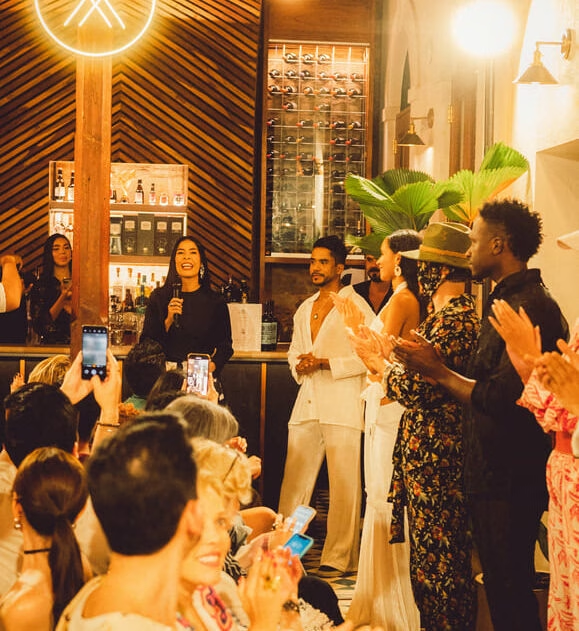
That backdrop changes what people expect from a meal. A restaurant in a modern high-rise in Punta Pacifica competes on menu and service alone. A restaurant in Casco Viejo competes on all of that plus atmosphere, and the better kitchens in the district understand that the setting sets an expectation the food then has to meet. Kaandela, housed within the old town and built around a wood-fired, farm-to-table approach to Panamanian cooking, was designed with that expectation in mind rather than treating the historic setting as a passive backdrop.
Geographically, the old town restaurant scene divides into a few informal zones worth knowing before you arrive. The area around Plaza de la Independencia and the cathedral holds some of the most photographed real estate in the district and, unsurprisingly, some of the highest foot traffic. The seawall promenade along Paseo de las Bóvedas offers water views and a more relaxed pace, popular for sunset drinks before dinner elsewhere. And the streets nearer Plaza Herrera, on the district’s northern edge, have developed a newer, slightly less polished restaurant row that appeals to a younger crowd and a livelier evening.
Anyone planning a visit built around the old town’s food scene should budget more time than a typical restaurant crawl requires elsewhere. The compact size of the peninsula is deceptive; narrow streets and constant visual distractions, from colorful facades to street art to impromptu music, slow down even a short walk between two addresses. Treating an evening in Casco Viejo as a leisurely wander rather than a point-to-point itinerary produces a far better experience than trying to move efficiently between reservations.
Reservations, regardless of which zone you choose, matter more here than the phrase “old town charm” suggests. Casco Viejo has become one of the most in-demand dining destinations in Central America, drawing both international visitors and Panama City residents willing to cross town for a night out. Walking in without a booking on a weekend evening is a real gamble, particularly at kitchens with a strong reputation and a small number of tables, which describes much of what makes the district worth visiting in the first place.
For a traveler who found this guide by searching for the best restaurants in Panama City’s old town, the short version is this: you were looking for Casco Viejo, you found the right neighborhood, and the restaurants worth prioritizing are the ones that treat the district’s history as part of the meal rather than incidental to it. Book ahead, give yourself time to wander, and expect the setting to do as much work as the kitchen.
The naming confusion is not just an English-language quirk. Panamanians themselves sometimes use “Casco Antiguo” and “Casco Viejo” almost interchangeably in everyday conversation, even though “Antiguo” is technically the more historically precise term and “Viejo” is the more common, colloquial one used in tourism marketing and on most signage. Visitors searching in Spanish will encounter both terms attached to the same restaurants, the same plazas, and the same neighborhood associations, which can add a second layer of confusion on top of the English “old town” translation if a visitor is cross-checking sources in both languages before a trip.
It is worth noting, too, that a small number of tour operators and older guidebooks still use “Old Panama” loosely to describe the restored district rather than reserving that name strictly for the Panamá Viejo ruins, which compounds the confusion for anyone researching from outside the country. When in doubt, the safest anchor point is the neighborhood’s UNESCO World Heritage designation, granted specifically to the restored colonial peninsula, since that official status attaches unambiguously to Casco Viejo and not to the separate archaeological site several kilometers away.